
Narrowcasting.
Your own screen, your own audience.
Narrowcasting is communication on digital screens at your own location, for the people who are there at that moment: customers in the shop, guests in the lobby, colleagues in the canteen, patients in the waiting room. It’s the opposite of broadcasting: you don’t send to everyone, but to a small group in a known place. The screen, the player and the software come from a supplier. What plays on them, we make: video and HTML that work from a distance and in passing, in your house style, and if you like as templates your team updates itself.
Narrowcasting or DOOH?
Both are digital screens, both show moving images. The difference is who owns the screen and who passes by.
| Narrowcasting | DOOH | |
|---|---|---|
| The screen | yours | a media owner’s, you rent time |
| Who watches | whoever is at your place: customer, guest, colleague | whoever passes: traveller, pedestrian, driver |
| What’s on it | what you want, when you want | your spot, in a loop with other advertisers |
| Costs | screen, player and software, no media space | media space, per week or per impression |
The overlap is bigger than it looks. A screen in your shop window facing the street is your own screen, but it is read like a bus shelter: from a few metres, in passing. The rules of DOOH apply there.
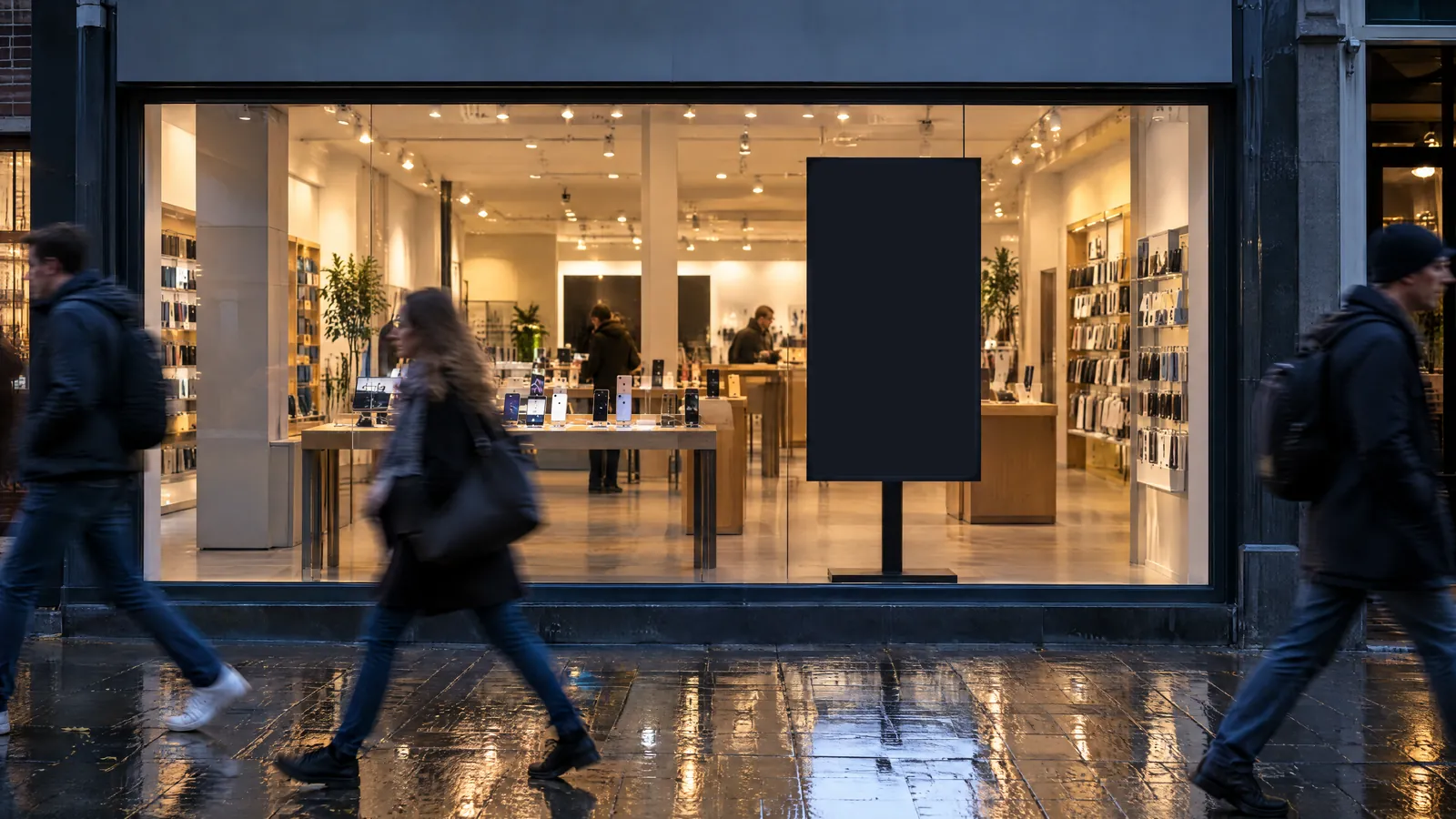
Now in the window
The shop was made with AI. The ads on the screen are real: we made them for Odido’s shops.
Where it hangs.
Every place has a different audience, and that decides how long someone looks.
- Shop and showroom. At the entrance, the shelf or the till. People keep walking: one product, a few seconds.
- Shop window. Read from the pavement: big, short and legible in daylight.
- Hospitality. The menu board, which changes with the time of day. Here people do look for a while, because they have to choose.
- Waiting room and reception. People sit there for ten minutes or more. Information works, a short loop starts to irritate.
- Office and canteen. News, figures, a welcome for visitors. The same audience every day, so it has to change often.
- Lobby, sport and events. Sponsors, the programme and showing the way, often on several screens at once.
Made for the distance and the seconds.
Nobody sits down in front of a screen on the wall. You glance at it while you walk, wait or queue, usually without sound. So:
- One message per frame. What isn’t clear in three seconds doesn’t get read.
- Big letters, few words. We check every design from the distance the screen hangs at, not on a laptop.
- Motion with a reason. First catch the eye, then calm enough to read.
- Everything on screen. No sound, no button. If you want someone to do something, say where: at the till, at reception, or with a QR code that scans from a distance.
- A loop that fits the place. In a shop, someone sees a few seconds; in a waiting room, the whole loop, maybe three times.
Video or HTML.
Video (MP4) plays on every player and in every system, and is finished the moment it is exported. Good for a brand film, a product animation or a promotion that runs for a month.
HTML is a small web page on the screen, just like an HTML5 banner. It works with whatever is true at that moment: the time of day, the weather, a countdown, prices or stock from a feed, the figures from a sheet. At eleven the menu board switches from breakfast to lunch by itself. Most professional players play HTML, such as BrightSign (opens in a new window) and Xibo (opens in a new window), and the screens from Samsung (Tizen) and LG (webOS).
If the connection or the data drops out, there is a base version that holds up on its own. How a screen works with its location, the clock and the weather, you can see in the bus shelter on our DOOH page. In the station concourse, Haastmakers for Odido counted down the days that way, by itself.
Templates you fill in yourself.
If something changes every week, an offer, a price or a bit of news, we build a template in your house style. The animation, the type and the layout are fixed; your team fills in the text, the price or the image, in the system you already have or in a sheet the screen reads. Made for your brand, so it doesn’t look like the neighbours’.
The specs we ask for up front.
We ask for this before we start, so everything fits first time.
| What | Why it matters |
|---|---|
| Resolution and orientation | Usually 1920 × 1080 landscape or 1080 × 1920 portrait, 4K is 3840 × 2160. Does the player rotate the picture itself, or does the file need to be rotated already? |
| File | Video as MP4 (H.264) plays almost everywhere. HTML as a zip with an index.html, if the system accepts it. |
| Frames per second | 25 or 30, whatever the player wants. Otherwise the motion stutters. |
| Length | How long an ad is on screen, and how long the whole loop is. |
| The edge | Some screens crop a little off the edge. We keep a safe margin. |
| Internet | If the ad runs offline, the base version plays, without live data. |
| Static elements | A logo that sits in the same spot day and night can burn in on some screens. We keep static parts moving subtly. |
What you get from us.
We make the content, not the screens or the software. That way we work with whatever system you already have, and our advice doesn’t depend on a package we want to sell. No screens yet? Then we think along about what the content needs, before you choose a supplier.
- Design and animation in your house style, made for distance and seconds.
- Video and HTML, with live data where it adds something.
- Templates your team fills in itself.
- Your campaign on your own screens. If it already runs as banners, social video or DOOH, the version for your shop or lobby is a small step: the same master, a different size.
- Checked on screen, at the size and distance it runs at, and delivered the way your system wants it.
Questions about narrowcasting.
Is narrowcasting the same as digital signage?
Almost. Digital signage is the broader, international term for digital screens and their technology. Narrowcasting is the Dutch name for what you do with them: a targeted message for the people in one place.
Does your content work with our narrowcasting system?
Almost always. An MP4 plays on every player, and most systems accept HTML too. Tell us the system and the player, and we’ll check up front what’s possible.
What does narrowcasting content cost?
That depends on the number of ads, video or HTML, and whether a template is part of it. You get a fixed price up front. Send your screens and what needs to go on them, and you’ll have a quote within one working day.
How long does it take?
That depends on the number of ads and whether there is live data in them. Within a working day of your briefing, you’ll know how long.